Meta didn’t just update its ad algorithm. It rebuilt the entire machine.
Over the past 24 months, I’ve managed millions in Meta spend across 7–9 figure DTC brands. Around late 2024 into early 2025, performance patterns started shifting in ways that no longer matched historical behavior.
Ads within the same campaign showed wide divergence in CPA, ROAS, and frequency. Delivery began shifting across age groups and placements, and performance became more volatile.
Broad targeting consistently outperformed carefully built lookalikes and interest audiences, with the system increasingly using creative itself as a signal. A phrase became more common: creative is the targeting.
The old frameworks stopped matching what I was seeing in the data. This wasn’t random. It was a system-level shift.
This wasn’t a single feature release. Meta introduced four structural systems that fundamentally reshaped how ad delivery works. Understanding them is now the difference between winning on Meta in 2026 and running outdated playbooks.
How These Systems Work Together
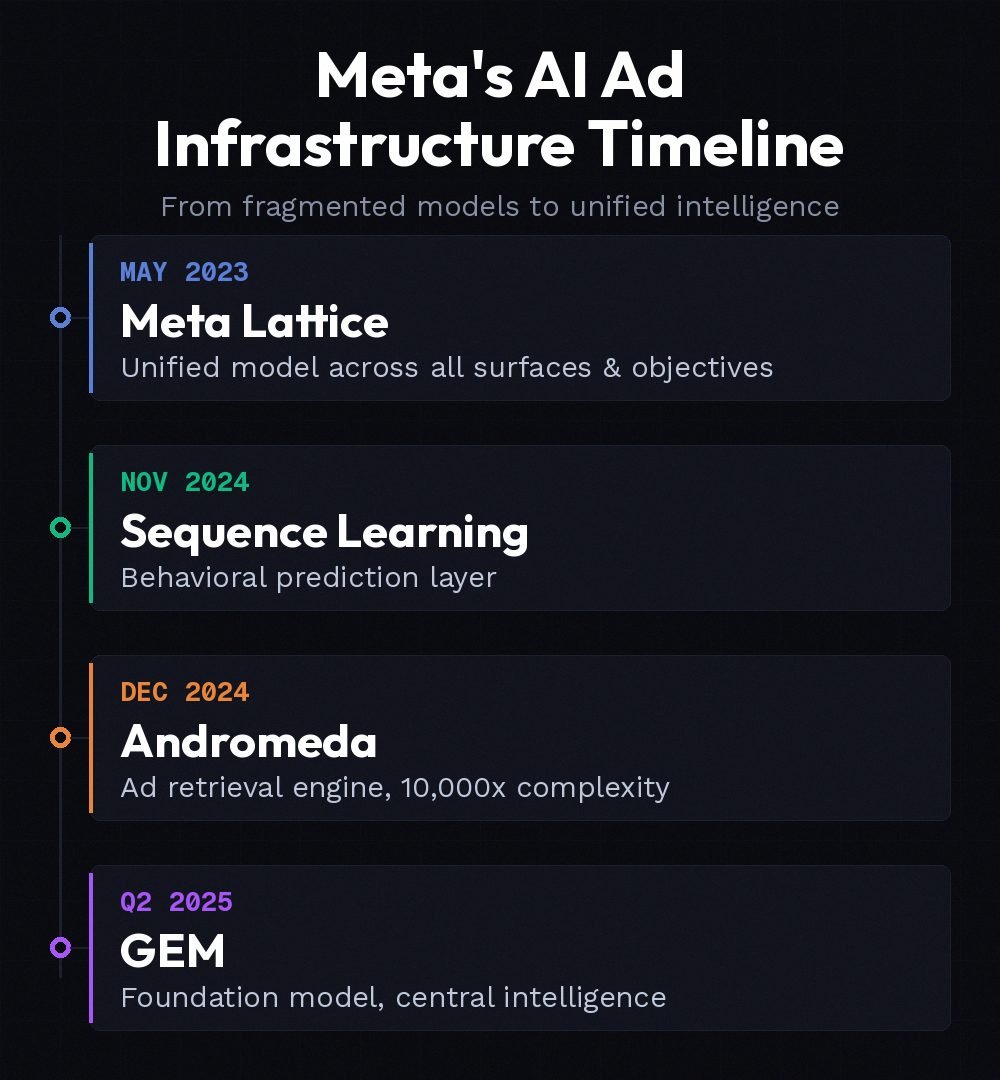
These aren’t four separate systems. They’re layers of a single, integrated AI engine.
The system operates as a continuous loop:
Sequence Learning predicts user intent → Lattice shares signals across the ecosystem → Andromeda retrieves the most relevant ads → GEM improves the predictions behind every step.
Every interaction, from what users watch and scroll past to what they click and purchase, feeds the system, refining its predictions about which creative to show each user next.
Sequence Learning: The Behavioral Prediction Layer
When did it release?
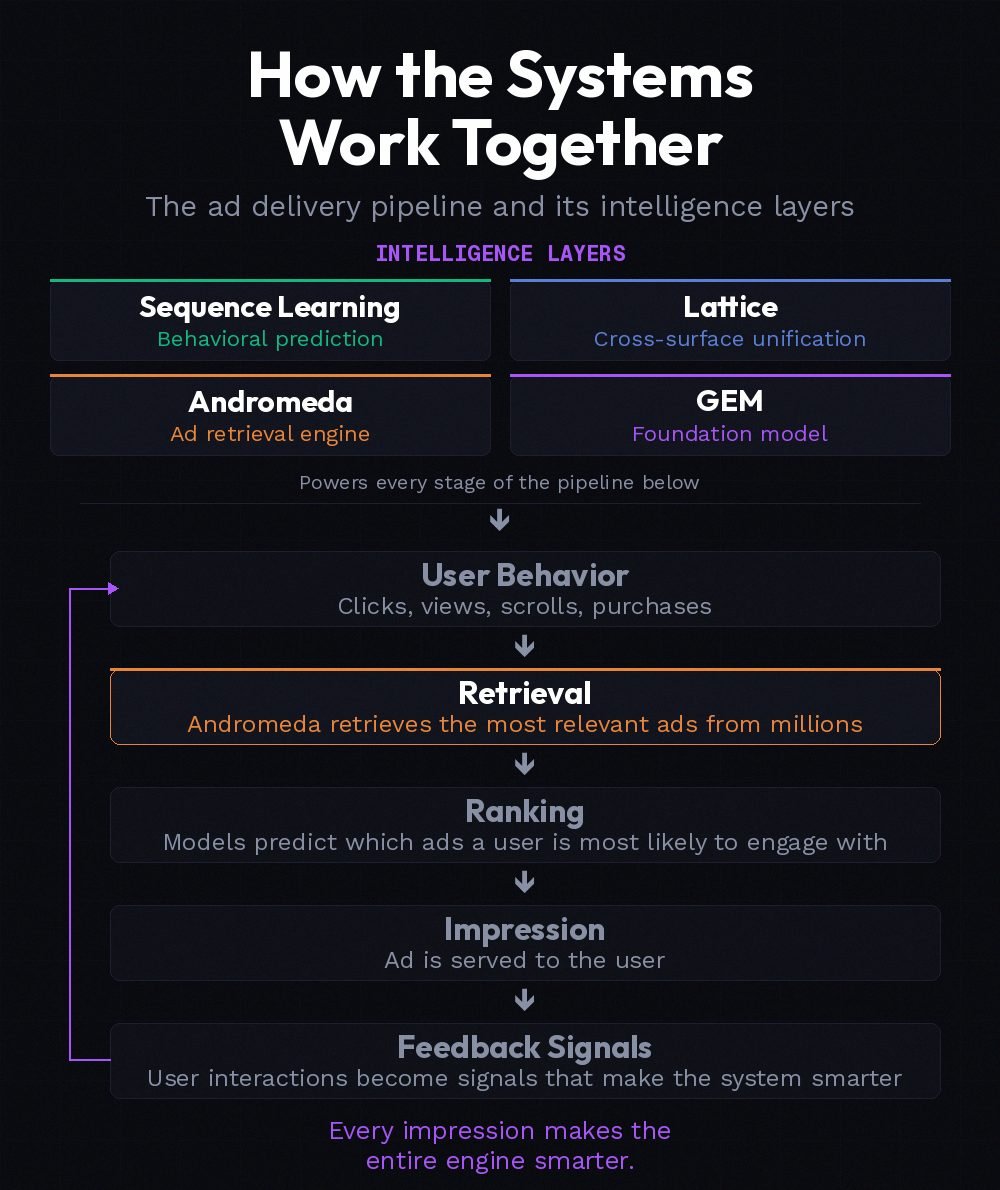
Publicly announced November 2024.
What is it?
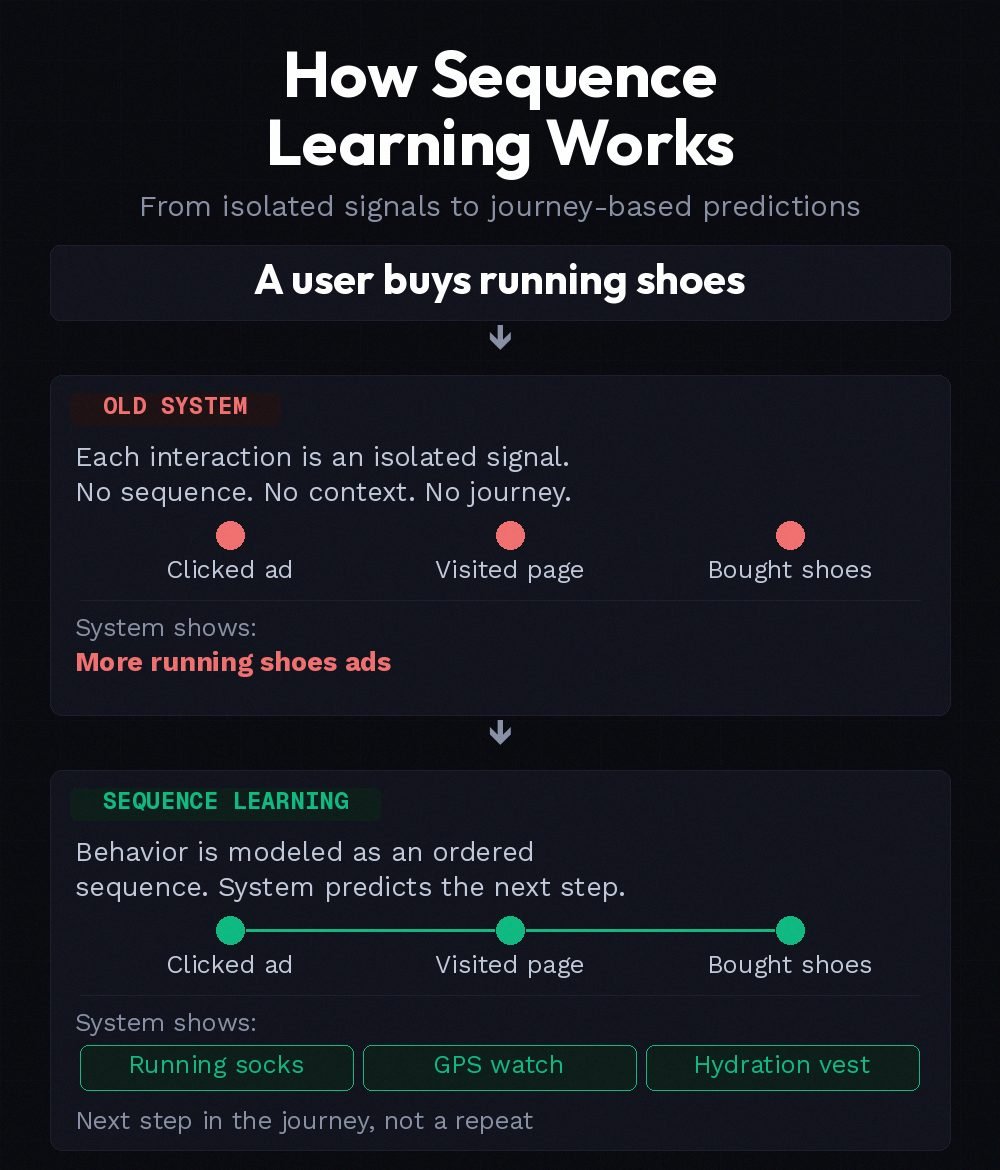
Sequence Learning ingests user behavior signals like ad interactions, page visits, purchases, and content engagement, models them as ordered sequences, and uses those sequences to predict the highest-probability next action.
The old system treated every interaction as isolated. Clicking on an ad was one signal. Visiting a product page was another. It couldn’t connect those actions or understand what they meant together.
You buy a pair of running shoes, then keep seeing ads for more running shoes. That’s the old system. With Sequence Learning, you’d start seeing ads for running socks, GPS watches, and accessories instead, because the system understands where you are in the journey and what you’re likely to need next.
Why does it matter?
Someone who just discovered your brand generates a different prediction than someone who added to cart but didn’t buy, which generates a different prediction than someone who already purchased. Those predictions feed directly into how the rest of the engine decides which ad to serve.
Meta Lattice: The Unified Model For Ad Knowledge & Prediction
When did it release?
Publicly announced May 2023.
What is it?
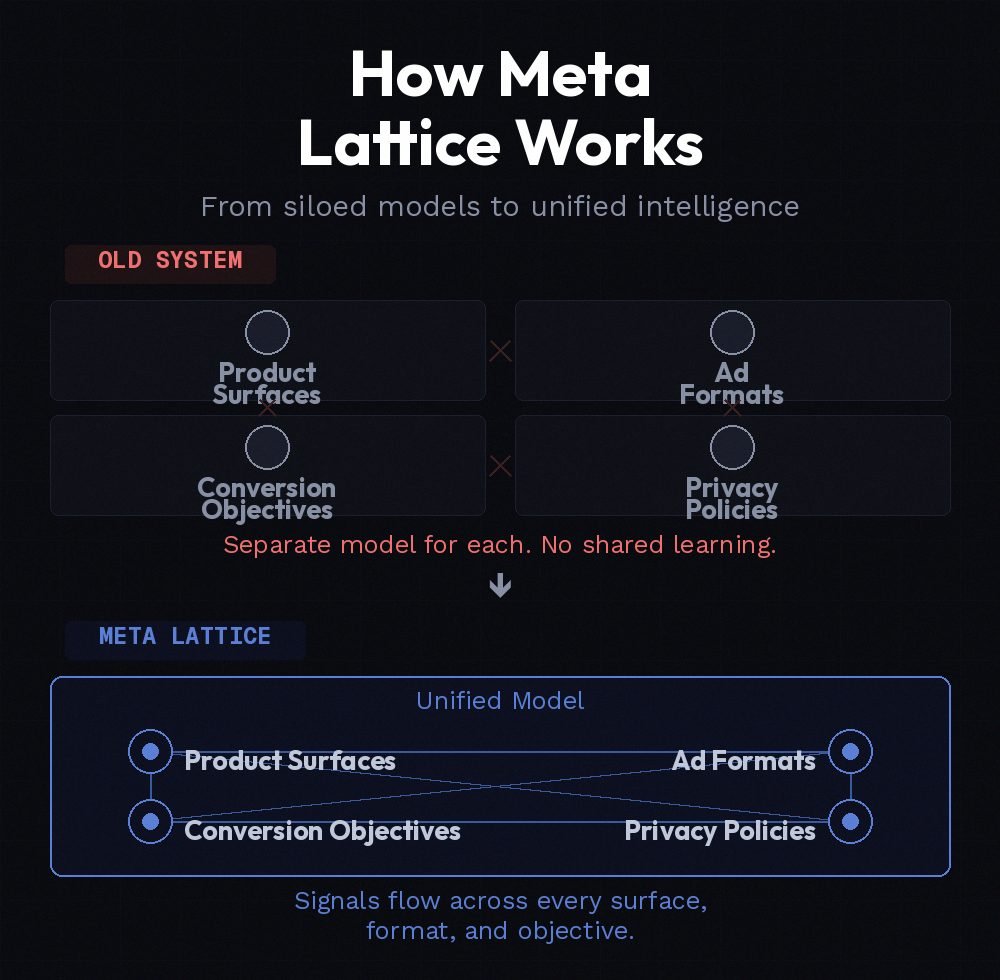
Before Lattice, Meta ran disconnected models for each surface and objective. Each model could only observe and learn from its own data. If someone watched your video ad on Reels but didn’t click, that signal stayed in Reels. It couldn’t inform what the system showed them in Feed.
Lattice connects these signals, ingesting behavioral data across every placement and objective so the system learns from the full ecosystem instead of isolated surfaces.
Why does it matter?
This is what makes Sequence Learning’s predictions cross-platform.
Without Lattice, the system could only model behavior within a single surface. With it, a user who watches your Reels video, scrolls past your Feed ad, and clicks your Stories ad generates one continuous sequence instead of three disconnected signals.
Every interaction across the ecosystem now informs a single, coordinated delivery decision instead of separate decisions within each placement.
Meta Andromeda: The Ad Retrieval Engine
When did it release?
Publicly announced December 2024.
What is it?
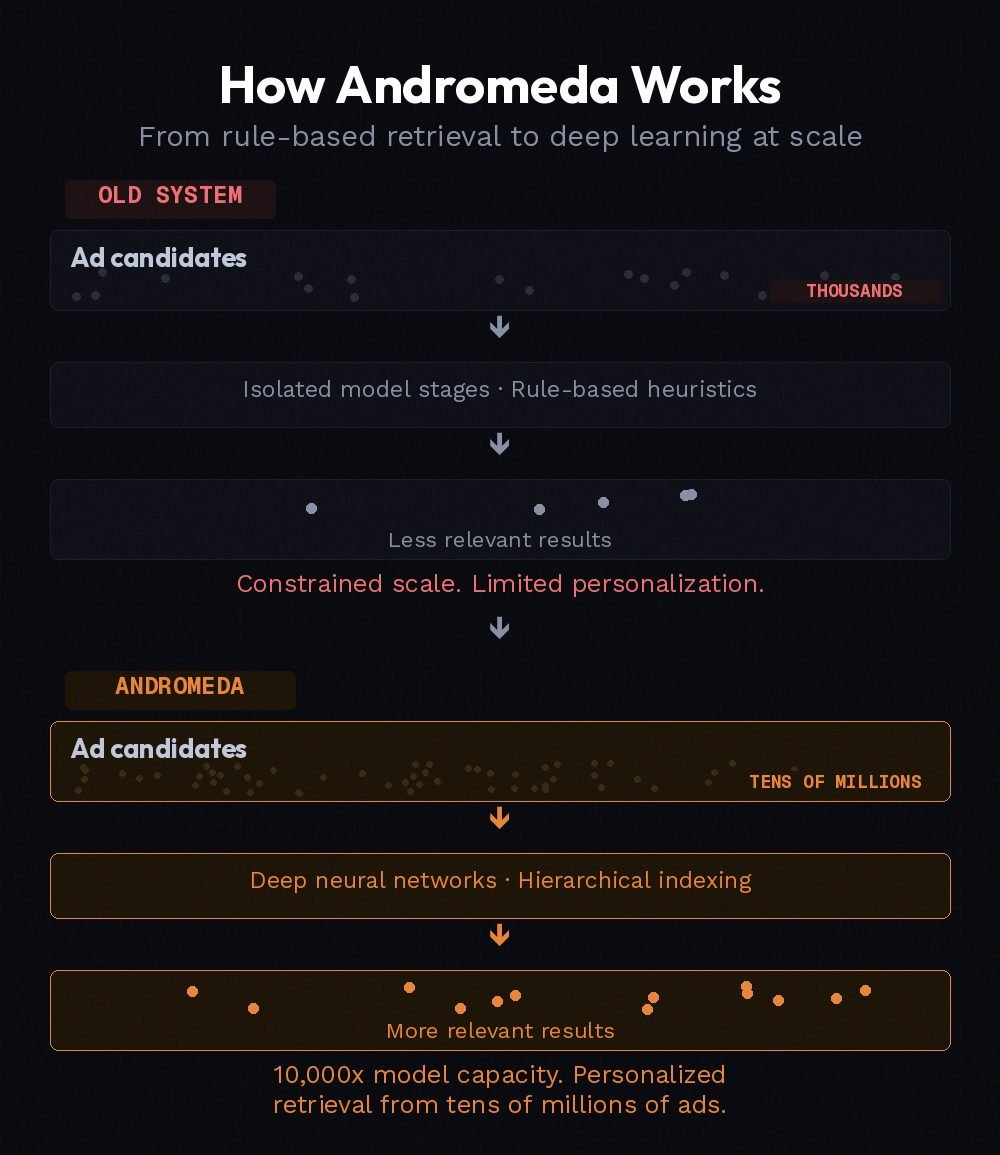
Andromeda ingests your creative assets, visuals, copy, format, messaging, and landing page as signals and uses them to retrieve and rank the most relevant ads for each user from a pool of millions in milliseconds. Audience targeting parameters still exist, but they’ve become suggestions, not rules.
Before Andromeda, advertisers relied on audience inputs like interests and lookalikes because the system could only evaluate thousands of ads per auction. That architecture depended heavily on tracking data, which eroded with AppTrackingTransparency (ATT), iOS 14.5+, and broader privacy changes.
Andromeda replaced that constraint with a far more advanced retrieval system, increasing retrieval capacity and model scale by roughly 10,000× and shifting the primary signal from audience inputs to the creative itself.
Why does it matter?
You can run a broad campaign with no audience targeting and multiple creatives, one speaking to new moms, one to college athletes, one to weekend hikers, and Andromeda will find each audience on its own. No interest stacks. No lookalike audiences. Creative has become the primary targeting signal.
Every winning ad becomes training data for the system. The better your creative performs, the more accurately the system learns which signals represent your ideal customer. Over time, this compounds.
Strong creative doesn’t just drive conversions. It teaches the system how to find more people like the ones converting.
But it cuts both ways. Your ads now compete in a pool of millions, not thousands, which raises the bar for creative quality.
Creative diversity is now the ceiling on scale. When every ad looks and sounds the same, the system runs out of signals to retrieve against.
Meta GEM (Generative Ads Recommendation Model): The Super Brain
When did it release?
Quietly rolled out in Q2 2025 but publicly announced November 2025.
What is it?
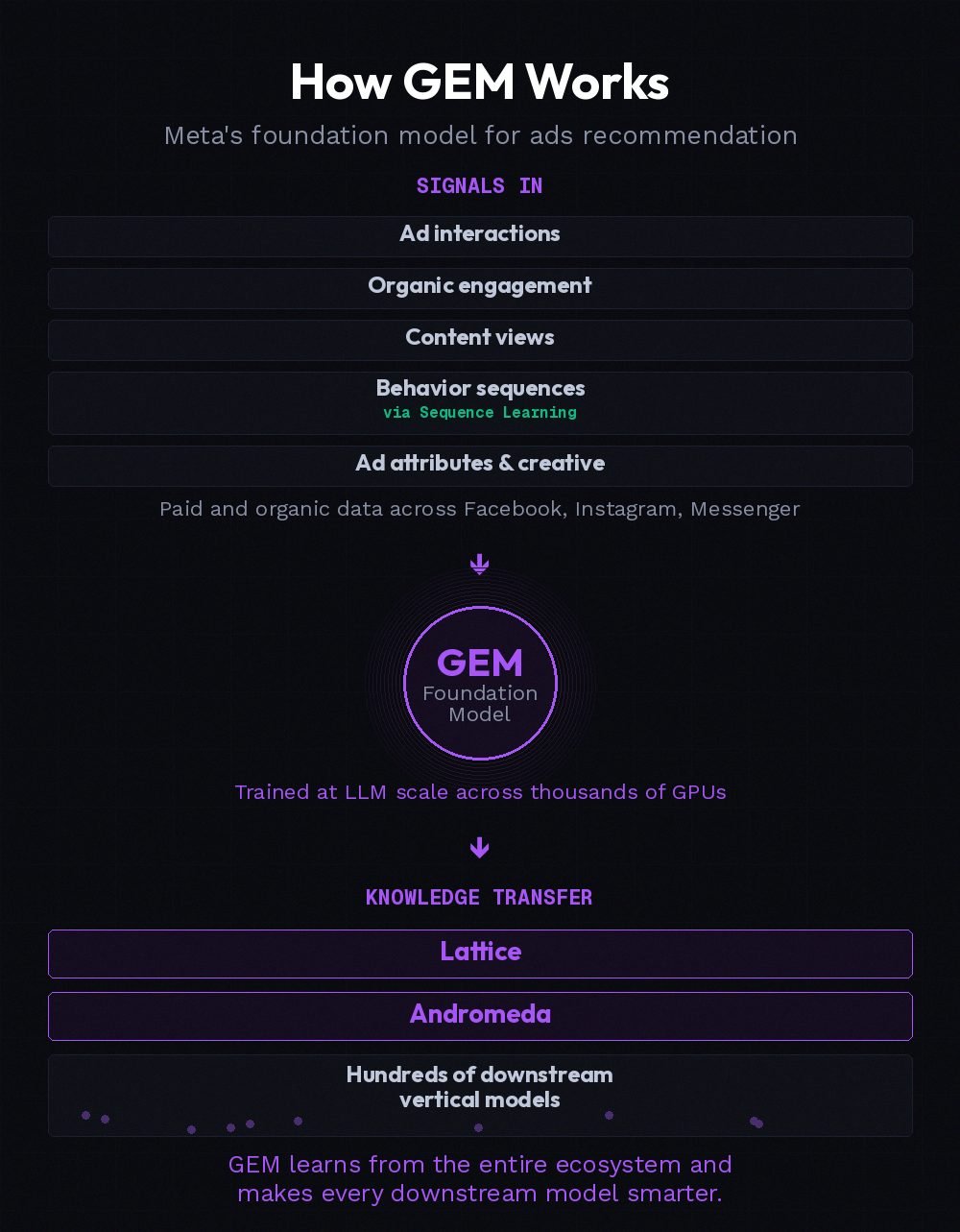
GEM is the central intelligence behind Meta’s entire ad system. It’s the largest foundation model built for ad recommendations, trained at a scale similar to large language models like Claude, Gemini, and ChatGPT.
Every interaction becomes a training signal: what people watch, scroll past, click, and purchase. GEM processes sequences of events per user across both paid and organic activity, synthesizing them into predictions about what each person is likely to do next.
Before GEM, Meta’s ad recommendation systems were fragmented, with multiple models connected by rule-based logic. GEM replaced that fragmentation with a single foundation model that propagates its learnings across the entire ads system.
Why does it matter?
GEM feeds its predictions directly into both Andromeda and Lattice, making both systems smarter. When Andromeda retrieves ads, it’s using GEM’s predictions. When Lattice shares signals across placements, it’s working from the same intelligence layer.
Because GEM learns from organic behavior, your organic strategy now directly impacts your paid performance. What people engage with across Reels, Feed, and Stories feeds the same system that determines your ad delivery.
What This Means for Your Strategy in 2026
Meta’s ad system is no longer primarily rule-based. It’s a continuously learning system that observes behavior, builds representations, and makes predictions from them.
The system can only learn from and retrieve against the signals you give it.
Everything comes down to inputs → predictions → retrieval.
The question is whether you’re giving it the right inputs. Good creative and clean data don’t just improve performance. They shape how the system learns.
Old Playbook → New Playbook
- Audience targeting → Creative-driven targeting
- Campaign structure → Signal quality
- Manual optimization → Model learning
- Isolated metrics → Sequenced outcomes
- Controlling delivery → Feeding the system inputs
- Winning ads → Continuous creative diversity
Build a creative system that generates signal diversity
One round of strong creative isn’t enough anymore. You need a repeatable system that produces genuinely different creative at volume. Not variations of the same concept. Entirely new concepts.
If your creative looks the same, speaks to the same persona, and communicates the same message, you’re not giving the system new signals to retrieve against. And the system can only scale what it can differentiate.
To grow, you need creative built across distinct stages of acquisition:
- Product-unaware: Lead with pain points and problems, delay product introduction.
- Product-aware: Focus on features and benefits for users actively evaluating.
- Brand-aware: Reinforce credibility, address objections, and build conviction.
Your testing framework should shift from audience variables to creative variables. The leverage is no longer in refining audiences. It’s in testing different signals: different reasons someone would buy, different use cases, different problems, and different moments of intent.
The bar for creative quality has also risen. Your ads are now competing against millions, not thousands. And even your best ads have a shelf life. When the system runs out of new signals, performance plateaus.
Stop over-optimizing individual ad performance
The system is optimizing for sequences of behavior, not individual impressions.
That means:
- Some ads exist to convert (high ROAS, higher frequency, lower reach)
- Others exist to qualify, educate, or move users forward (lower ROAS, lower frequency, higher reach)
If you judge everything on the same ROAS target, you’ll remove the data the system needs to model sequences and predict future conversions.
The same applies to placements. Reels might not convert directly, but it may be shaping the sequence that leads to a conversion elsewhere.
Your landing page is part of the system
Andromeda can find the right user. GEM can predict intent. But conversion still depends on what happens after the click.
If your landing page doesn’t convert, you’re training the system on bad outcomes:
- That your audience isn’t valuable
- That your creative isn’t relevant
- That your offer doesn’t work
That feedback loop degrades prediction accuracy across the entire system.
Your landing page is also part of the input layer. The system ingests it to better understand who to show your ads to. Optimizing post-click experience improves both conversion and targeting.
Get your data infrastructure right
These systems learn from your event data.
If your Pixel and CAPI setup is noisy, delayed, or incomplete, the system isn’t just less efficient. It’s learning the wrong patterns.
Better data doesn’t just improve targeting. It increases how quickly and accurately the system learns who your highest-value customers are and how to find more of them.
Audience exclusions and segmentation still matter, not for targeting, but for helping the system understand where users are in their journey.
Invest in organic
GEM learns from organic behavior. What people engage with across Reels, Feed, and Stories feeds the same system that determines your ad delivery.
Organic isn’t just top-of-funnel anymore. It’s training data that shapes how the system finds your next customer before you even spend.
If you haven’t prioritized it, now you have a clear reason to.
Accept the new role
The media buyer is no longer an optimizer. They’re a system designer.
You’re not selecting audiences or tweaking bids.
You’re designing the inputs:
- Creative
- Data
- Post-click experience
And those inputs determine how the system learns and what it prioritizes.
Every time you reset campaigns too early or make large changes, you interrupt that learning.
Let it compound. That’s how the system wins.
Closing Thoughts
The old playbook is done.
Meta has rebuilt the engine. It now models behavior as a sequence, shares intelligence across every surface, retrieves ads based on creative signals, and improves with every interaction.
The system is more powerful than ever. But it only works as well as the inputs it’s given.
The brands that win align with how the system learns:
- More creative volume, but more importantly, more creative diversity
- Cleaner, faster data
- Stronger post-click experiences
- And the patience to let the system compound
The brands that struggle will keep trying to outsmart it:
More targeting. More control. More manual optimization.
The system doesn’t need better targeting. It needs better inputs.
Resources & Further Reading:
- https://engineering.fb.com/2024/11/19/data-infrastructure/sequence-learning-personalized-ads-recommendations/
- https://ai.meta.com/blog/ai-ads-performance-efficiency-meta-lattice/
- https://engineering.fb.com/2024/12/02/production-engineering/meta-andromeda-advantage-automation-next-gen-personalized-ads-retrieval-engine/
- https://engineering.fb.com/2025/11/10/ml-applications/metas-generative-ads-model-gem-the-central-brain-accelerating-ads-recommendation-ai-innovation/
- https://www.foxwelldigital.com/blog/metas-andromeda-in-laymans-terms